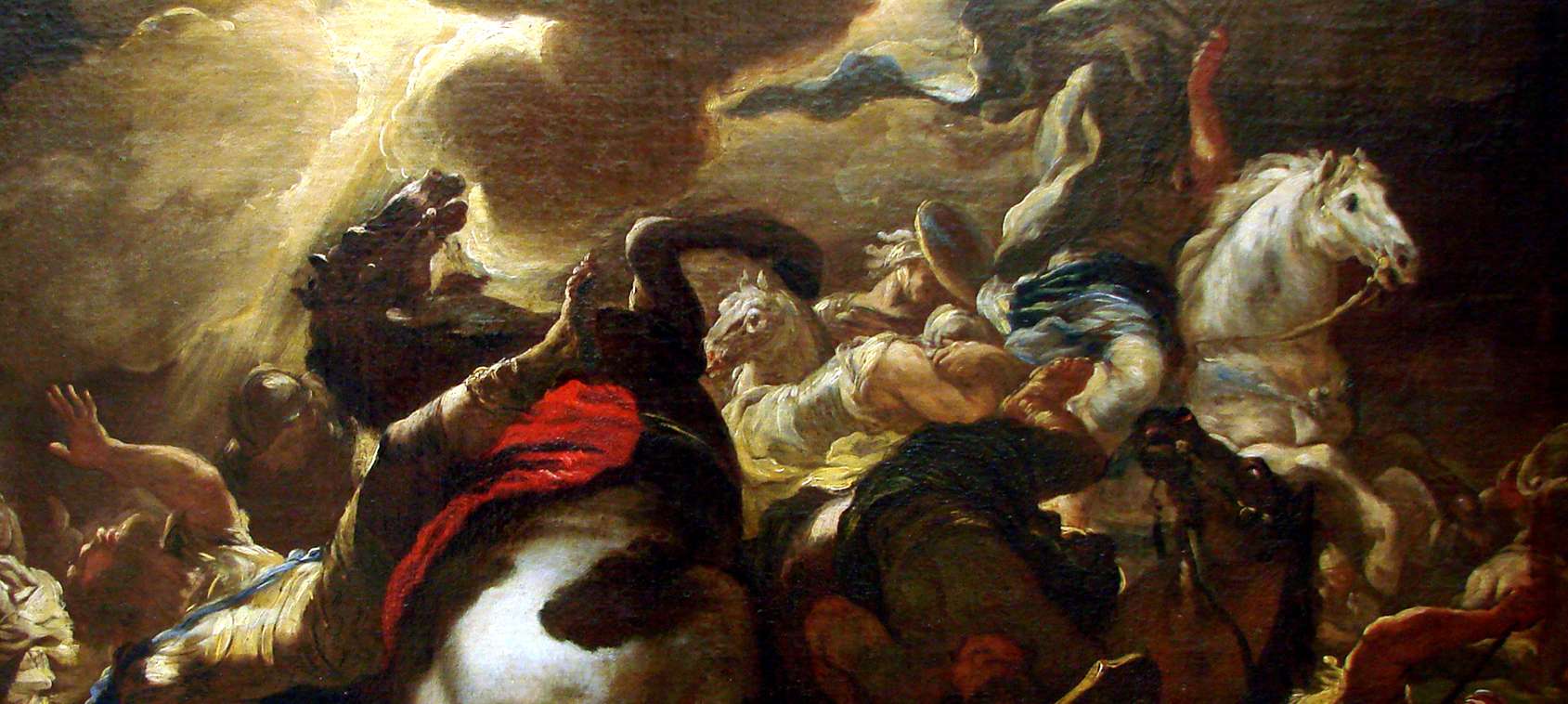
The Road to Damascus
Over the centuries following the Babylonian exile, God’s nation had morphed into a religion. The idea emerged that alongside his written law, God had also transmitted an “oral law” to Moses, which had been handed down through the priestly caste, and was now in the hands of the “rabbis”, the teachers of the law. Two of the great rabbis of the age were Hillel and Shammai, whose two schools did much to form Judaism. Hillel’s was the more enduring of the two schools, and his grandson Gamaliel was a member of the high council when the apostles were brought before them to be tried and, hopefully, executed. Gamaliel was able to reduce the sentence to a flogging, arguing:
Let them go! For if their purpose or activity is of human origin, it will fail. But if it is from God, you will not be able to stop these men; you will only find yourselves fighting against God. (Acts 5:38,39)
But Gamaliel was no fan of the emerging faith. His disciple, Saul, “was still breathing out murderous threats against the Lord’s disciples” (Acts 9:1) He would later say of himself “I studied under Gamaliel and was thoroughly trained in the law of our ancestors. I was just as zealous for God as any of you are today. I persecuted the followers of this Way to their death, arresting both men and women and throwing them into prison” (Acts 22:3,4)
But something changed for Saul. On the road to Damascus, where he intended to root out “any there who belonged to the Way, whether men or women, he might take them as prisoners to Jerusalem” (Acts 9:2), he was confronted by the risen Christ:
Suddenly a light from heaven flashed around him. He fell to the ground and heard a voice say to him, “Saul, Saul, why do you persecute me?” “Who are you, Lord?” Saul asked. “I am Jesus, whom you are persecuting,” he replied. “Now get up and go into the city, and you will be told what you must do.” The men travelling with Saul stood there speechless; they heard the sound but did not see anyone. (Acts 9: 3-7)
Saul’s conversion was dramatic. Already deeply versed in scripture, he spent several days with the disciples in Damascus (v 20), who evidently passed on what Jesus had taught them.
At once he began to preach in the synagogues that Jesus is the Son of God. All those who heard him were astonished and asked, “Isn’t he the man who raised havoc in Jerusalem among those who call on this name? And hasn’t he come here to take them as prisoners to the chief priests?” Yet Saul grew more and more powerful and baffled the Jews living in Damascus by proving that Jesus is the Messiah. (Acts 9:20-22)
Saul, or Paul (as he would come to be known), wrote most of the letters that make up the bulk of the New Testament. He expanded on Jesus’ teaching to such an extent that Christianity is sometimes accused of basing its beliefs on Paul rather than Jesus, as though the two were in some way in conflict. They had been, but that was now in the past.